Posted by SolidShops on March 14, 2012 at 11:48 AM
Finding the best ecommerce solution for building an online store isn’t always easy. You can choose between going the open source route or you can go for a fully hosted SaaS application. Both approaches have their advantages and disadvantages. In this post I’ll try to clarify the differences between both to help you decide which approach is best for your business.
Before you continue reading, you should know that we ourselves are a commercial and hosted solution. In this article I’m simply trying to demonstrate and clarify what the difference is between open source software and commercial hosted ecommerce solutions.
There is no clear winner here, it all depends on what you exact needs are. Let’s get started, shall we?
An open source solution isn’t free
Let’s get a misconception out of the way first. A big advantage is that you can download and implement open source ecommerce solutions free of charge. That means you don’t have to pay a license to download or use the software.
What that also means is that you are responsible for installing, maintaining, securing and configuring the software on your own servers. Unless you are a technical person yourself with lots of free time, setting up an open source solution will take up time.
For most people, time is a valuable thing and you will need to charge your client for the time you spend setting up an open source solution. That cost adds up.
If you are not a technical person yourself, you will need to hire a web designer or developer that can take care of this process for you. By the time you’ve got a working setup, open source isn’t as free anymore as you might thought is was.

Illustration by: http://www.flickr.com/photos/hikingartist
But how can a hosted solution be more cost effective than free?
As you know by now, open source isn’t free unless you’re doing all the work of setting up an open source solution yourself and your time isn’t worth a penny. Even then, you still have to pay for hosting, SSL security and again spend time on maintaining the software whenever an upgrade comes out.
A simple comparison
Let’s take a look at the basic tasks that one has to tackle when using an open source solution.
- installing and setting up the open source solution: 1-2 hours
- buying and installing an SSL certificate for one year: 1 hour (costs between 30$ and 150$ yearly)
- hosting your ecommerce store: 150$ yearly (cheap estimate)
- renewing the SSL certificate every year (1 hour)
- updating/patching the open source software every few months (4 hours)
Of course, rates depend on where you are but it’s fair for a web developer to charge you 50$ an hour over here.
8 * 50$ + 150$ + 30$ for the SSL equals 580$ upfront costs just to get your open source solution up and running.
This is just the cost for going the open source route and I’m not exactly exaggerating prices here. Of course, this is just an estimate to show you that there are costs associated with open source solutions, unlike what many clients tend to think.
For that same money you can have a store running on SolidShops for nearly two years, without going through the hassle of managing it all yourself. Here is what using a hosted and commercial package like SolidShops would cost you:
- creating your store: 5 minutes, pricing starts at 29$ a month per store
- installing SSL on your checkout page: not necessary, it’s already included
- hosting your ecommerce store: included in all pricing plans
- renewing the SSL certificate every year: we’ll take care of that as well
- updating/patching the software when a bug arises: we’ll do that for you
Sometimes, open source is better
Open source is definitely a better choice for you if you want to be able to develop your own code on top of the open source solution you are using. For example, if you are unhappy with the way your checkout process is working, it will be a lot easier to change an open source solution if you are willing to put in the hours and money to do so.
When using a hosted solution, you cannot just change the software for the simple reason that you can’t change the source code of the hosted software. That’s what the team behind the hosted solution is doing. On the other hand, that means you don’t have to worry about bugs or improvements to the software. They will be made available by the hosted solution provider.
Is a hosted solution flexible enough for me?
Again, this depends. What I can say is that SolidShops focuses on making it really easy for a web designer to build out unique themes for a store. Building themes and layouts with SolidShops is a walk in the park compared to the complex systems many open source solution offer.
Many open source solutions tend to be too big and too complex for many small to medium sized businesses. On the other hand, if your business requires that complexity, going the open source route might be a good choice for you.
Anything that can be customized in a store-front can be customized with SolidShops, from the look and feel to the PDF invoices and order emails your clients receive so we’ve got your covered there.
Conclusion: the best ecommerce solution is…
I’m afraid there isn’t one simple answer here. The best thing you can do to pick the best ecommerce solution for your business is getting honest information. If you are in doubt, I’d love to give my own honest take on what solution might be best for your specific situation.
At SolidShops, we try to inform everybody that gets in touch with us about the pros and cons of picking a certain solution. In the end, the only one that can tell you what’s best for you is you. This article hopefully gets some misconceptions out of the way.
Before you go shopping, inform your self about the pros and cons and you’ll make the right choice without a doubt.
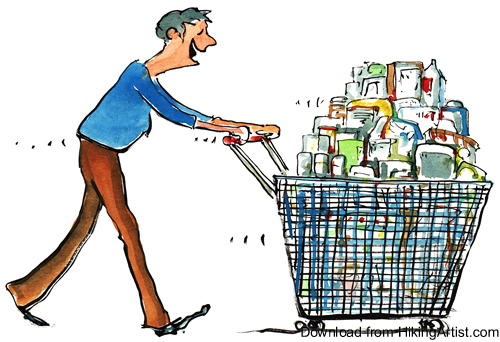
Illustration by http://www.flickr.com/photos/hikingartist
Shoot an email if you have any questions or post your comments below, I’d love to hear your thoughts.
Posted by SolidShops on December 29, 2010 at 11:37 AM
From time to time we get asked if SolidShop is a good alternative to the open source eCommerce packages such as Magento, osCommerce and Ubercart.
For the impatient that are seeking a quick answer: yes, SolidShop is a good alternative to all the eCommerce solutions mentioned here, but of course, a few remarks must be made.
Open source isn’t always “free”
Let’s face it, Magento and Ubercart are great open source products to build an online online store, if you have the technical expertise and especially a lot of time (and thus large client budgets) you can spend on installing, securing and continuously patching these applications.
I am a web designer myself and I have used Magento in the past as well. Why? Because it’s open source, flexible and free of course!
But once you start working with these products, you will quickly notice that free isn’t always free. First of all, to run any of the popular open source eCommerce solutions out there, you will need the following:
- Hosting to put your shop online
- At least one SSL certificate to secure your checkout pages and process
- Time to install and configure the software
- Time to upgrade your free open source packages and to keep up with security updates
- Time to build a unique design for your clients in your product of choice
Add up all that time and “free” open source packages suddenly sound a lot more costly than they did before don’t they? And if you are building stores for clients, the worst thing is, they will have to pay the bill for all those hours you put into configuring, installing and securing a free product. In many cases, clients will even ask you themselves to use a free open source package. It’s up to you to educate your clients about the advantages, but also about the disadvantages of using open source packages.
How often do you hear your clients say “I want you to use Drupal instead of Expression Engine as a CMS, because Drupal is free”. Sure it’s free, but it’s not the right tool for just any job out there and in the end it might cost the client much more compared to using the right tool for the job, even if that tool isn’t free or open source.
A hosted eCommerce platform may be a better fit for you if you want to get up and running quickly and only focus on building and designing the online business. Although you or your clients pay a monthly price for useing SolidShops, you will be up and running within a few minutes after signing up for an account. There is nothing to install and security is already in place for you.
Also, there is no need to update your software, as we’ll take care of that for you automatically. We are deploying a new version of our software almost every two weeks, which includes bug fixes as well as new features our clients are asking for.
There are no extra hosting costs, these are included in all our pricing plans.
That brings us to designing your store. Being web designers ourselves we know what you need to design stores easily. So we rolled out a flexible, easy-to-use templating language you can use to build your 100% custom HTML and CSS templates. If you can build it in HTML/CSS, you can build it in SolidShops.
SolidShops isn’t a perfect match for everybody
After reading the introduction above, you may think that SolidShops is the perfect tool for any online store, but let me be honest here: it isn’t.
Because SolidShops is a hosted eCommerce solution, you are not able to just change our source code, that would be a bad idea for our clients. If you are a store builder that needs 100% access to source code and like to write custom modules for some extreme off-standards web shop, then SolidShops probably isn’t the right solution for you.
Magento, osCommerce and Ubercart all allow you to extend or modify their source code, which is a good thing, if you are into that sort of thing of course. SolidShops is focused on making eCommerce as simple and enjoyable as it can be.
If you are not looking for an easy to use tool to build and design online stores, we suggest you stay with open source packages that can be extended at will.
Conclusion: SolidShops is…
… GREAT for you if you don’t like to hack into source code to get things up and running.
… GREAT for you if you want to save time and hassle when building an online store.
… GREAT for you if you like designing in HTML/CSS to create a unique look and feel for your stores. See an example of our templating language
… NOT for you if you like to spend time hacking and extending source code.
… NOT for you if you aren’t making at least 29$/month with your store.
… NOT for you if you have unlimited time/budget to configure, update, maintain and install open source software.
As you can see, SolidShops isn’t necessarily a perfect fit for everyone or for every project and we don’t claim it to be. As a designer, you should find the type of platform you feel most comfortable with and go with that.
People that aren’t interested in using a hosted eCommerce platform such as SolidShops can find open source alternatives on the following links:
Tripwire Magazine: 15 Open Source eCommerce Platforms
Web Distortion: 10 kick ass Open source E-commerce platforms reviewed
Web Appers: 15 Best Free Open Source Ecommerce Platforms
If you are interested in giving SolidShops a try, you can sign up for a free trial right here. No credit card is required.
Posted by SolidShops on December 09, 2010 at 12:21 PM
So you’ve decided to go with SolidShops to set up your online store. A wise move indeed.But why do you still need a PayPal account to receive payments you might ask? Well, simply because you need a way to safely receive money on to your bank account. That’s where PayPal comes in.
PayPal – which is owned by eBay – is the preferred way of paying online for most people. Even if someone doesn’t have a PayPal account, they can just pay in your store with any supported credit card, without the need to create a PayPal account.
The best way to go is to create a PayPal Business account. There is no monthly fee for these accounts, but PayPal does charge you a certain percentage and cost per order you get. These typically range somewhere between 1% to 3% plus a few cents per transaction. Check out the “fees” link at the bottom of the PayPal website for exact details.
While we dream of a world where these kind of middle-men services don’t charge a thing for their services, in reality most of them still do. Unlike many of our competitors, SolidShops itself will never charge you a commission per sale.
Follow the steps below to create and configure a PayPal account and link it to your SolidShops store. Let us know if you have any questions in the comments or through the support page in your account.
1. Create a PayPal Premier or Business account
Start on the PayPal website and click on the Sign Up link.
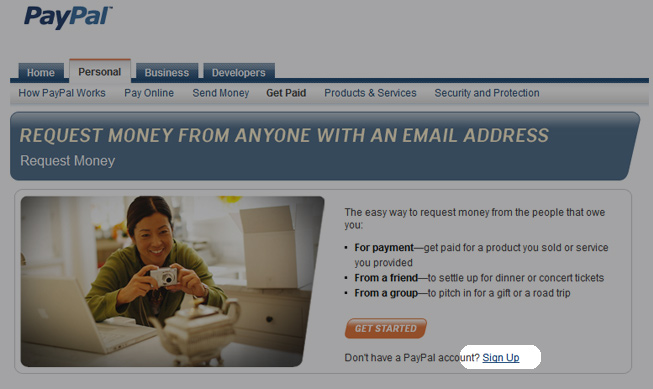
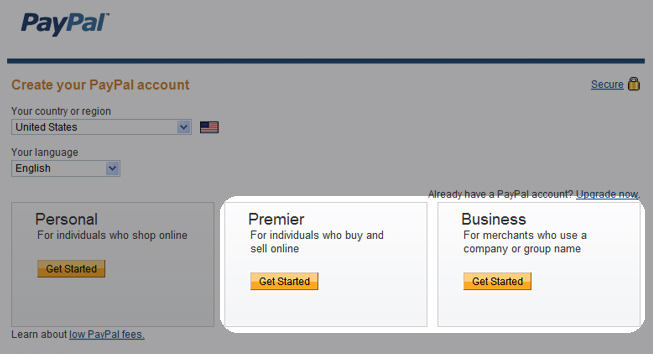
2. Select region, then create a “Business Account”
While the personal or premier account types are viable options as well, they do not support payments without a PayPal account. When you select a Business account, you will be able to receive payments from clients by credit card, without the need for them to create a PayPal account.
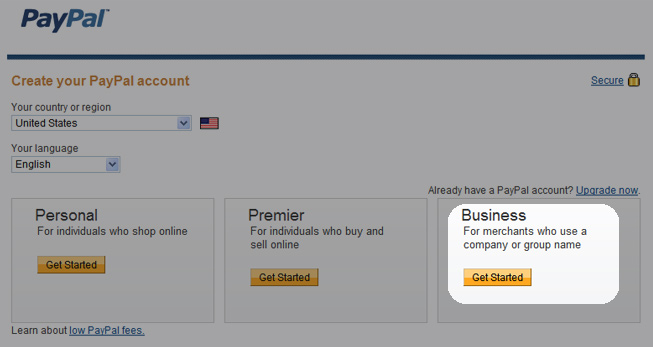
After selecting the Business plan, fill out the PayPal registration form to complete your registration.
3. Add “Website Payments Standard” to your payment methods
You will be receiving payments by credit card by using Paypal’s “Website Payments Standard” method. Please select this method for your business by following the following steps.
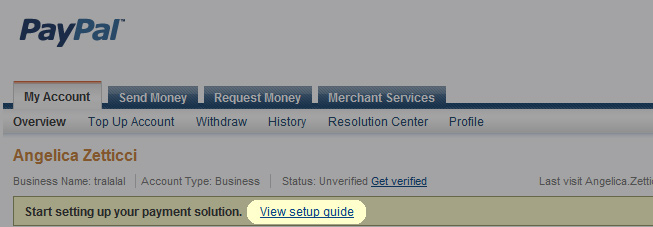
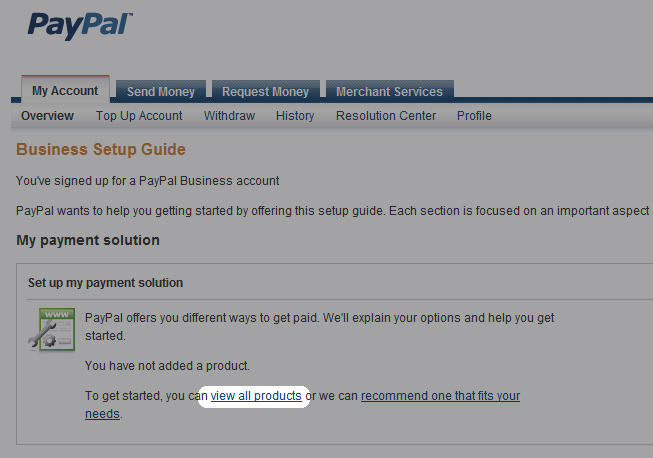
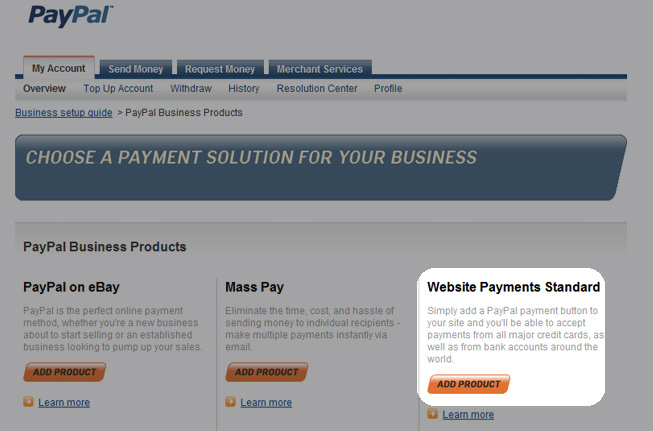
4. Link your PayPal account to SolidShops and you are all set
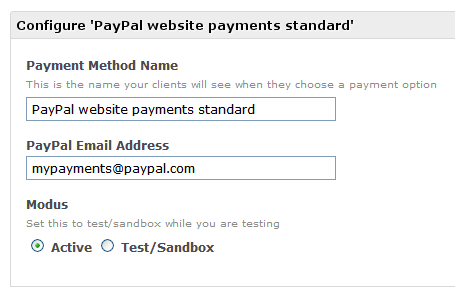
Now that you added Website Payments Standard to your payments methods, you can link up your PayPal account to your SolidShops store by just hooking up your PayPal email address, like this:
Log in to your SolidShops store and go to the “Settings” tab where you can click on the “Payments” link. Here you can simply connect your PayPal account to your SolidShops store. Your clients will now be able to pay using credit cards or using a PayPal account.
Posted by SolidShops on July 07, 2010 at 10:13 AM
According to an article that was published in the Belgian newspapers today (yes, we are from Belgium!), there was a massive rise in online sales generated by women every time there was a World Cup soccer match on TV. At the same time their boyfriends and husbands were drinking beers and watching the game on TV, a lot of women would escape the World Cup madness by relaxing behind a laptop and by spending some cash online.
Top sold items seemed to be underwear, jewelry and summer dresses. Some online stores even noticed an increase of 300% in sales during soccer matches. Other good news for Belgian shop owners is that online spendings have grown with 17% in 2009. According to BEcommerce – the organization that watches over online store owners in Belgium – sales will go up another 15% in 2010.


Let's get social shall we?
We'd love to know what you think. Join the conversation about your hosted e-commerce solution.